

- Latch Infinity
- Education & EdTech
Campus Films That Actually Drive Admissions: What Universities Get Wrong
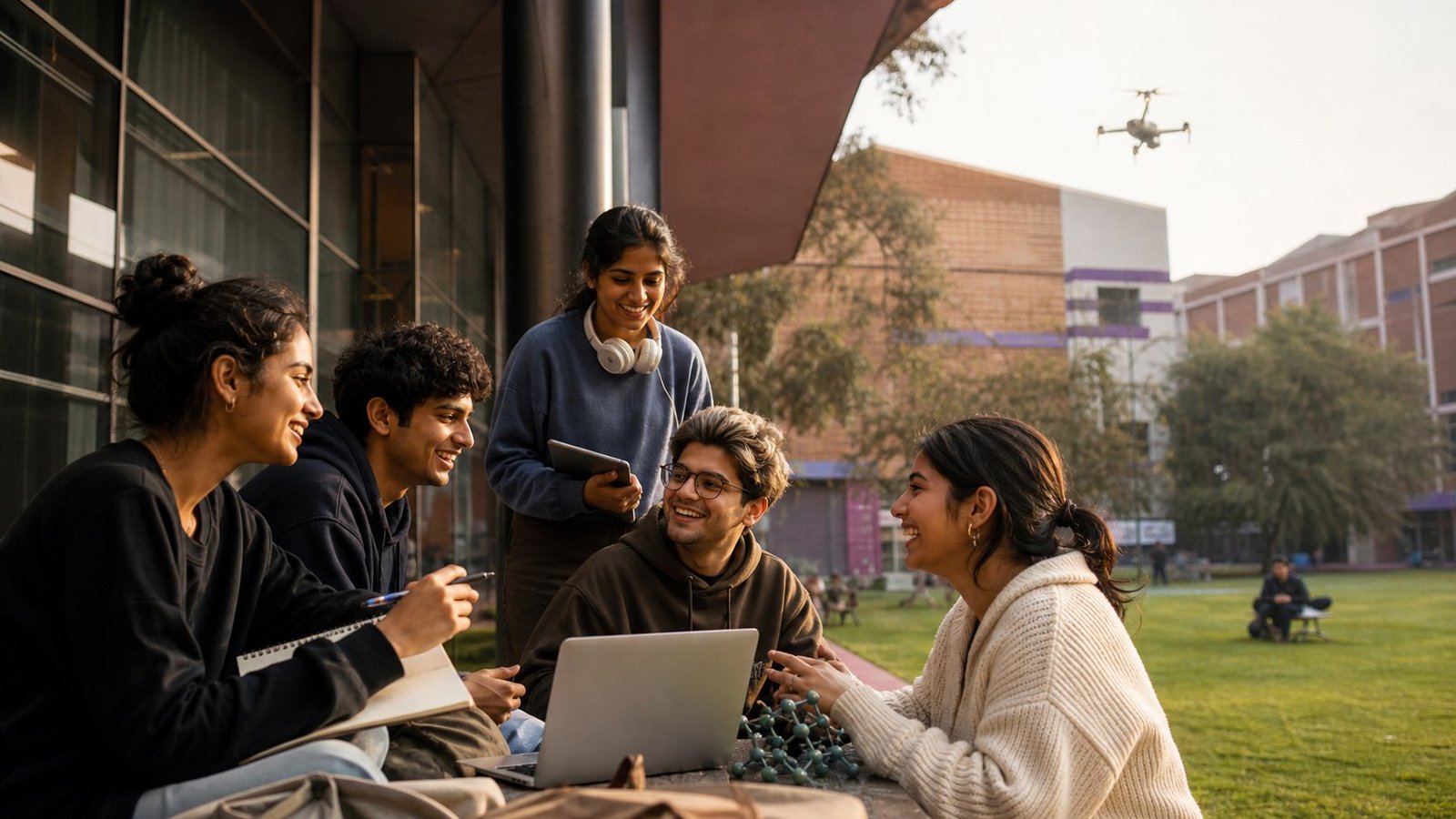
Watch ten Indian university campus films back to back and a strange thing happens. You start predicting them.
Drone rises over lawn. Students walk purposefully in slow motion, laughing at a joke nobody told. Library. Lab, someone holding a pipette with great significance. Cricket match. Vice-Chancellor addresses camera on the subject of holistic development. Strings swell. Logo.
It’s competent. It’s also structurally identical to the film made by the institution ranked twenty places above you and twenty places below you. And it is doing approximately nothing for admissions, because it’s a confident answer to a question nobody asked.
What prospective students are actually up to
The behaviour is well documented and slightly humbling. Around 78% of prospective students start their research on Google. Video is overwhelmingly the format they want - roughly 72% say they prefer virtual tours and video over traditional brochures. Nearly 90% of teenagers use YouTube, about three-quarters of them daily.
But here’s the finding that should reshape your entire content plan: day-in-the-life vlogs pull roughly three times the engagement of promotional campus videos.
Students aren’t searching for institutional positioning. They’re searching for a simulation of their own life on your campus. The institution makes a film about the institution. The student wants a film about themselves. That gap is where the money disappears.
Mistake one: opening on the drone
The aerial exists for two reasons - it’s the most expensive-looking image available per rupee, and campus decision-makers are genuinely proud of the campus. Both are true. Neither is a viewer benefit.
A 17-year-old scrolling YouTube has no idea what your buildings look like from 120 metres and no frame of reference to be impressed by it. Worse, the aerial opening is the single most generic three seconds in higher education marketing - spent at the exact moment the viewer decides whether to stay.
Open on a face. A hand. A specific human doing a specific thing. If you must use the aerial, drop it in the middle as a transition, where its geographic information is actually doing a job.
Mistake two: casting for polish instead of candour
The students in most campus films were chosen by the marketing team for being articulate, presentable and - the real criterion - available on shoot day. They deliver flawless lines about world-class faculty and excellent placement opportunities.
Viewers detect this instantly. It reads as advertising, and advertising is what they were trying to see past.
The students who actually convert sound like they’re talking to a friend, not a lens. They mention the specific thing they were nervous about before joining and what actually happened. The fix is unglamorous: interview twenty students with no script, ask what surprised them, and build the film out of the answers. Cast for candour. The best line in a campus film is almost never in the brief - it’s the thing someone says while the crew is packing up.
Mistake three: one film, four audiences, zero fit
An engineering aspirant, a design aspirant, an international applicant and a parent want four completely different things. One institutional film tries to serve all of them and quietly serves none.
Parents want safety, structure, placement outcomes and cost. Domestic aspirants want peer culture, hostel life and what the campus is like at 10pm on a Wednesday. International students want visa support, food, community and airport logistics. Programme aspirants want the labs, the studios, the faculty in their discipline.
Modular beats longer, every time. From one production block, build:
• A three-minute institutional film for the homepage and formal contexts • Six to eight programme-specific films at 90 seconds each • A day-in-the-life series, largely shot by students themselves • A parent-directed film on safety, outcomes and support • A pile of vertical cutdowns for Instagram and YouTube Shorts
One crew, one week, one grade. Four audiences, each getting a film that was actually made for them.
Mistake four: shooting when the campus is asleep
Campus films are usually shot in whichever week the crew was free - which is often a quiet week, because that’s when timetables permit. The result is empty corridors, a canteen with three people in it, and a campus that reads as recently evacuated.
Shoot during peak chaos. Fest week. Open day. Exam season. First week of term. A full, noisy, alive campus communicates belonging in a way no voiceover has ever managed. If the calendar forces a quiet week, plan and cast your crowd scenes deliberately rather than hoping some students wander through.
Mistake five: no vertical, no Shorts, no plan
A four-minute 16:9 film uploaded to the website and a YouTube channel with 900 subscribers is not a distribution strategy. It’s a filing system.
Prospective students are not visiting your channel. They’re being served things in a feed. So every campus production should also generate a library of vertical short-form assets built for discovery: a hostel room tour, a canteen taste test, the walk from the main gate to the department, three students on “what I wish I’d known before joining.” These cost very little alongside the main shoot and they’re the only assets that reach people who’ve never heard of you.
Then pair them with the formats that convert further down: virtual tours, which convert a meaningful share of attendees into inquiries when run as live events, and personalised video messages from admissions, which have been linked to notable lifts in commitment rates.
What a good campus film does instead
It answers a question. “What’s it actually like to study here?” is a far better brief than “showcase our campus.”
It’s specific. The professor who runs the robotics lab. The dish everyone queues for. The 24-hour reading room. The exact bus that goes into the city. Specificity is what makes a place feel real and a film feel true.
It shows the ordinary. Not just convocation and fest. The walk to class in the rain. The empty studio at midnight. The group project argument. Prospective students are trying to picture a daily life, not a highlight reel.
It has a next step. Every film should land somewhere concrete - the programme page, the application, a campus visit booking, the WhatsApp counsellor. A film that ends on a logo has thrown its conversion in the bin and walked away.
Measuring it like you mean it
Views are not the metric. Views have never been the metric.
Track completion rate by audience segment, click-through from video to programme page, assisted conversions where a video view precedes an application, and enquiry attribution asking new applicants where they first encountered you.
If a film can’t be tied to a measurable step in the admissions funnel, it’s a brand asset rather than an admissions asset. That’s a perfectly respectable thing to be - it just needs to be
budgeted and judged as one, rather than defended at the end of the year as though it were both.
The cheapest content you’re not making
Here’s the awkward economics of campus video: the content that performs best is often the content that costs least.
Student-generated content - a hostel tour shot on a phone, a genuine reaction to results day, a room makeover, an exam-week vlog - routinely outperforms professionally produced films on the platforms where discovery actually happens. It’s not because production quality doesn’t matter. It’s because credibility matters more, and a polished film is inherently less credible as testimony than a shaky one.
The mistake institutions make is either ignoring this entirely or over-managing it into oblivion. A student ambassador programme with a 12-point brand guideline and a three- stage approval process produces content that looks exactly like marketing, which defeats the entire purpose.
A workable middle path:
• Recruit 8 to 12 student creators per intake, across programmes and backgrounds, and pay them properly. Free pizza is not a content strategy.
• Give them prompts, not scripts. “Show us your Sunday” produces better results than “highlight our library facilities.”
• Set three non-negotiables, not thirty: no other students filmed without consent, nothing filmed in restricted areas, nothing that misrepresents facts about the programme.
• Review for those three things only. Resist the urge to note that the room was untidy. The untidy room is the point.
• Give them equipment and editing support, not creative direction. A decent mic and a tripod raise the floor without flattening the voice.
Run alongside your professional production, this gives you two content streams with different jobs: the crafted films that carry the institution’s positioning, and the honest ones that answer the question every applicant is actually asking - what would my life be like here?