

- Latch Infinity
- Video Production
Corporate Film vs. Brand Film vs. Ad Film: What Your Business Actually Needs
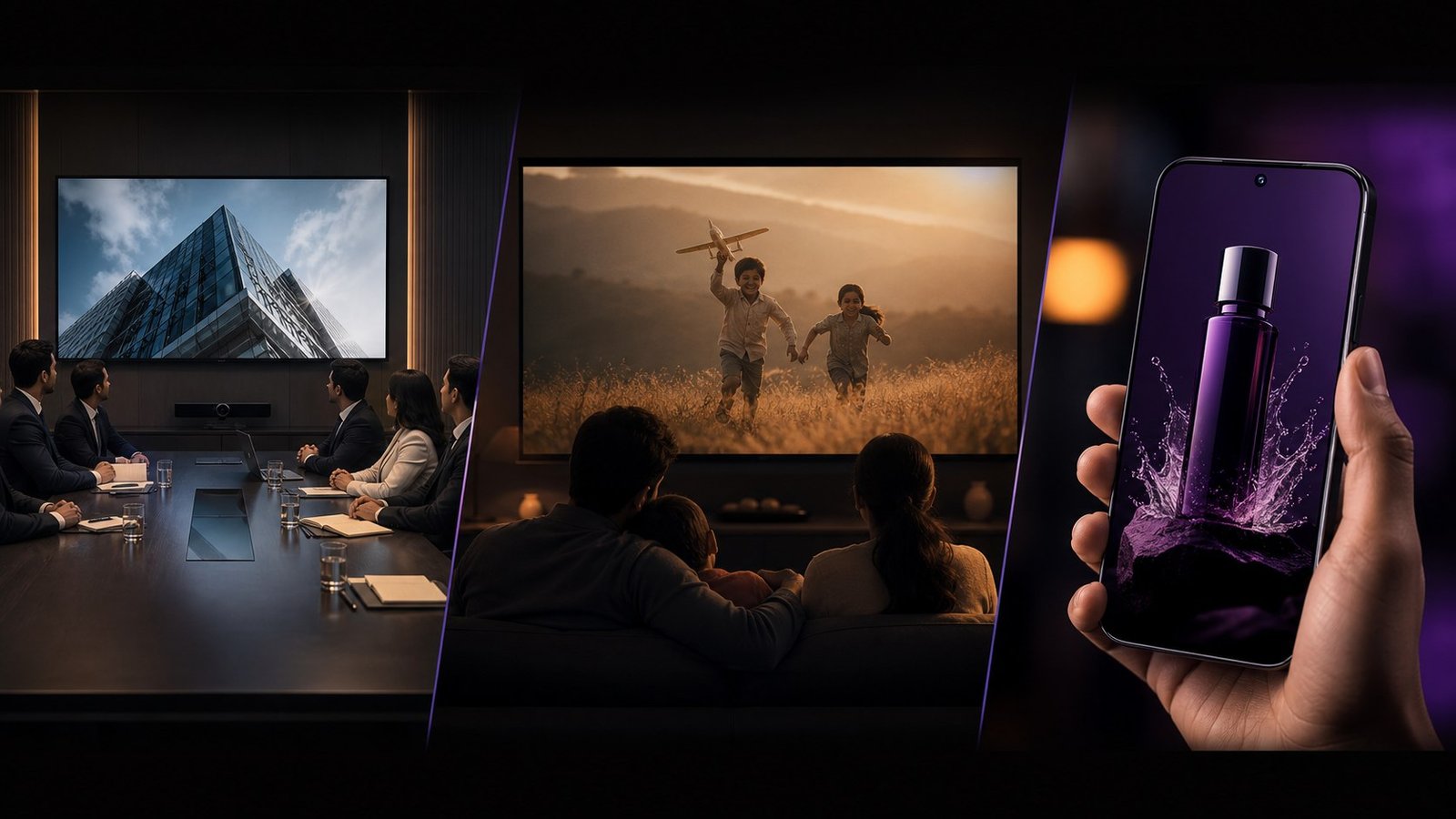
Every video brief in history begins the same way: “We need a video for the website.”
Three weeks later, deep in pre-production, the truth emerges like a plot twist. The video is also for the trade show booth. And the sales team’s laptops. And the investor meeting. And, someone mentions casually on a Thursday, Instagram.
That’s four films. There is one budget. Nobody is having a good time.
The confusion is fair, to be honest. Corporate film, brand film and ad film all involve a camera, a crew, and a colourist who hasn’t slept. But they answer different questions, they’re watched by wildly different people in wildly different states of attention, and they’re graded against completely different numbers. Picking the wrong one is the most expensive mistake in video - mostly because you only discover it after the money has left the building.
So let’s sort them out.
The corporate film: proof that you are, in fact, real
A corporate film explains what your organisation does, how it does it, and why it can be trusted to keep doing it on a Tuesday when nobody’s watching. It’s your capability deck, but with a heartbeat.
Its audience is almost always someone already in a conversation with you - a prospect mid- evaluation, a partner doing due diligence, a candidate weighing an offer, an auditor with a clipboard and no sense of humour. Crucially, these people chose to press play. They are not scrolling. That single fact changes everything.
Length: two to five minutes. Contains: facilities, process, scale, certifications, leadership, outcomes. Lives on: the About page, sales decks, tender submissions, reception screens, onboarding. Judged by: completion rate among a small, expensive audience - and whether the sales team actually sends it to anyone.
We worked with a manufacturing client whose plant genuinely wowed anyone who walked through it. Inconveniently, flying a prospect to Bangalore cost more than the margin on a first order. The corporate film existed to shrink that walkthrough into an email attachment. Its success metric was never views. It was how many prospects reached the technical conversation without ever boarding a plane.
The classic corporate film failure? Trying to make it exciting. Slow-motion sparks and an aspirational voiceover do absolutely nothing for a procurement head who has read four hundred capability decks this year. Specificity does. The actual tolerance you hold. The actual test rig. The actual person who runs it, who has opinions about it.
The brand film: making people feel something long before they need you
A brand film sells a belief, not a capability. Its entire job is to make people who don’t currently need you remember you when they finally do.
Where the corporate film says here’s what we do, the brand film says here’s what we think the world should look like. Usually there’s no product demo. Often no feature list. Sometimes no explicit call to action at all - which makes finance nervous and is, nevertheless, correct. What it has instead is a point of view strong enough to survive being watched once and recalled six months later in a meeting you weren’t in.
Length: 60 seconds to three minutes. Contains: narrative, human characters, a thematic idea, and craft you can feel. Lives on: the website hero, YouTube, LinkedIn, event opens, culture moments. Judged by: recall, shares, the quality of the response - and whether people actually finish it.
Brand films are where cinematography earns its keep. The gap between a competent brand film and a memorable one is almost entirely craft: casting, lighting, sound design, edit rhythm. None of it survives being cheapened. Which leads to an uncomfortable rule: if the budget can’t support proper craft, don’t make a brand film. A mediocre brand film doesn’t communicate “modest budget.” It communicates “mediocre brand.”
The upside is longevity. A good brand film runs for three to five years. Spread across that lifespan, the annual cost is often lower than the ad films you cheerfully bin every quarter.
The ad film: buying attention, then asking for something
An ad film is built to be interrupted into. It plays before content the viewer actually wanted, inside a feed they were scrolling past, or during a break they used to make tea. It has to win the first three seconds, then convert. No warm-up lap.
Everything about the format follows from that. Hook first, logo later. State the proposition - don’t imply it. Have a call to action, and make it embarrassingly clear. And here’s the part clients resist: ad films work as sets. You test them against each other, and you retire the losers without sentiment.
Length: six to 60 seconds, delivered as multiple cutdowns. Contains: hook, problem, proposition, proof, CTA. Lives on: Meta, YouTube, programmatic, connected TV, cinema. Judged by: cost per view, thumb-stop rate, click-through, and eventually cost per acquisition.
The most useful mental shift for anyone moving into ad film: the deliverable isn’t a film, it’s a campaign asset library. One shoot should produce a whole family - different hooks, different lengths, different ratios, different proof points - because the media buying will tell
you within a fortnight which ones deserve money. Making one perfect ad film and running it for a year is how creative fatigue quietly eats your performance while everyone congratulates each other on the edit.
Choosing: three questions, no jargon
Forget format. Start here.
Who’s watching, and did they choose to? A chosen audience tolerates length and rewards substance - corporate territory. An unchosen audience must be won in three seconds - ad film. An audience you want to influence before they’re in-market - brand film.
What decision are you trying to move? Trust and capability → corporate. Preference and memory → brand. Immediate action → ad.
How long does this need to survive? “Until the next campaign” → build an ad set. “The next three years” → build a brand film and shoot it properly. “Until the product line changes” → corporate film, edited modularly so you can swap sections without a full reshoot.
The efficient answer: one shoot, three outputs
Here’s the good news. The formats are distinct. The shoot days don’t have to be.
A well-planned two-day shoot at a facility can yield a four-minute corporate film, a 90- second brand film, and six ad cutdowns - provided the shot list was built for all three from the beginning.
That planning is the entire game. Brand film wants performance and controlled light. Corporate film wants coverage and clarity. Ad film wants vertical framing and hook-first composition. Decide all of it on day zero and you get three films for roughly the cost of 1.4. Decide it in the edit and you get one film that does three jobs badly, which is somehow the most expensive outcome of all.
Where the time and money actually go
One more thing worth knowing before you commission anything, because the cost distribution surprises almost everyone.
Corporate film is cheap to shoot and expensive to organise. The camera work is straightforward. What takes time is access - plant permissions, safety inductions, shutting down a line for twenty minutes, getting a director who is genuinely busy to sit still. Budget your effort in coordination, not in kit. The other silent cost is approvals: corporate films are reviewed by legal, compliance, HR and the MD, often sequentially, often with contradictory notes. Build three review rounds into the timeline and you’ll finish on schedule. Build one and you won’t.
Brand film is expensive to shoot and expensive to prepare. Casting, location recce, art direction, a proper grade and original sound design are where the money goes, and none of
them are optional if the film is meant to last three years. The good news is that the approval process is usually shorter, because fewer people feel qualified to give notes on a mood.
Ad film is cheap per asset and expensive in volume. Any single cutdown is trivial. Producing thirty of them, versioned across ratios and lengths, with captions and platform- specific exports, is a genuine post-production project. This is the line item most often underestimated in a scope, and the one that causes the most awkward conversations in week six.
Knowing which curve you’re on lets you brief realistically - and lets you spot a quote that has priced the shoot correctly and the rest of the job not at all.